
The Mycocultural Revolution, Part 2: Mycoculture as a Production Solution
By David Law, CEO and President, Gourmet Mushrooms, Inc.
Previously, I outlined the problems and opportunities facing a globe poised to grow by two billion in the next 40 years. I believe one agricultural system already speaks directly to the goal of feeding nine billion sustainably on a finite planet — one that is routinely overlooked: mycoculture, sometimes called “fungiculture,” or large-scale mushroom cultivation.
Modern mushroom cultivation is surprisingly young. Reliable, controlled production at scale has only emerged within the past 300 years. While wild mushrooms have been consumed seasonally across many cultures for millennia, mushrooms are still often perceived as a niche or seasonal food—even though they are now grown year-round in highly controlled environments. In many ways, our cultural relationship with fungi has not yet caught up with our technical capabilities.
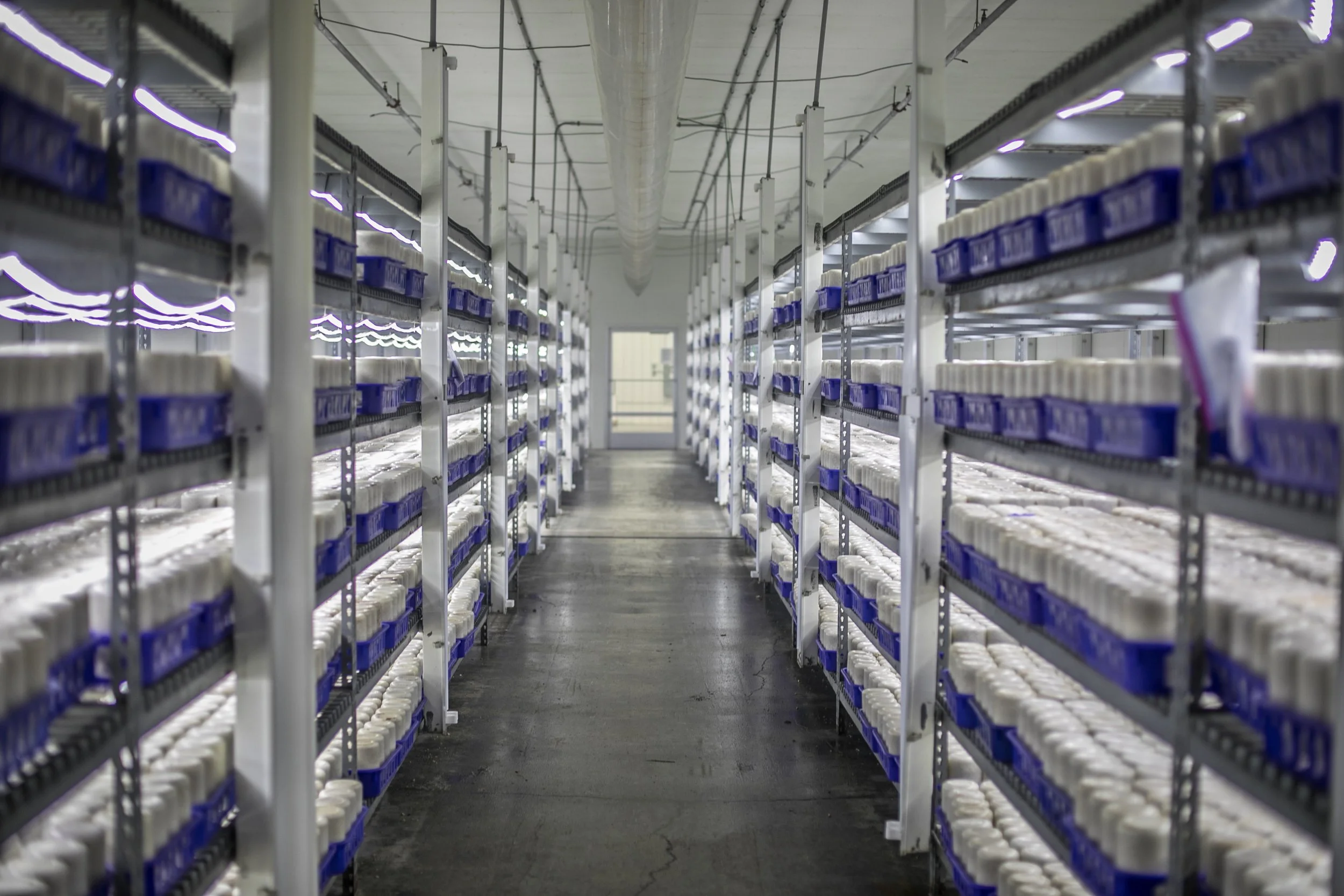
The incredibly dense, space- and resource-efficient operations of a commercial mushroom farm
From a production standpoint, mushrooms offer a rare alignment of economic incentive and environmental restraint.
Incentives for farmers. Specialty mushrooms are typically grown indoors in environmentally controlled facilities. This allows for continuous, year-round production while minimizing risks from weather, drought, and climate volatility. Although capital costs are higher, productivity per unit of land—and per unit of time—is exceptionally high.
Food and Agriculture Organization data from 2011 illustrates the contrast. Global rice production totaled roughly 7.7 million metric tons, grown across 163 million hectares of land. Asparagus production reached about 8.2 million metric tons on 1.47 million hectares. In the same year, global mushroom production was approximately 7.7 million metric tons—produced on the equivalent of just 21,000 hectares, largely indoors. Measured by yield and by revenue per hectare, mushrooms dramatically outperform many conventional crops.
| Mushroom | Rice | Asparagus | |
| Production (1,000 tons) | 7,719 | 722,560 | 8,197 |
| Hectares (1,000) | 21 | 163,147 | 1,465 |
| Tons/hectare | 367.57 | 4.43 | 5.6 |
| $/kilogram | $2.57 | $0.45 | $2.20 |
| Revenue/hectare | $944,659 | $1,993 | $12,309 |
Water efficiency. Mushroom cultivation is also extraordinarily water-efficient. A SureHarvest study sponsored by the Mushroom Council found that producing one ton of mushrooms requires roughly 16.7 cubic feet of water. By comparison, producing one ton of rice can require approximately 1,275 cubic meters of water. On a relative basis, mushrooms use only a fraction of the water required by most staple crops.
Smarter diets. Today, global mushroom production is roughly comparable to that of asparagus, and the fungal kingdom remains underrepresented in the human diet. If mushroom consumption were scaled even to the level of broccoli—requiring roughly a ten-fold increase in production—it could represent a meaningful and environmentally sustainable contribution to feeding the next two billion people.