
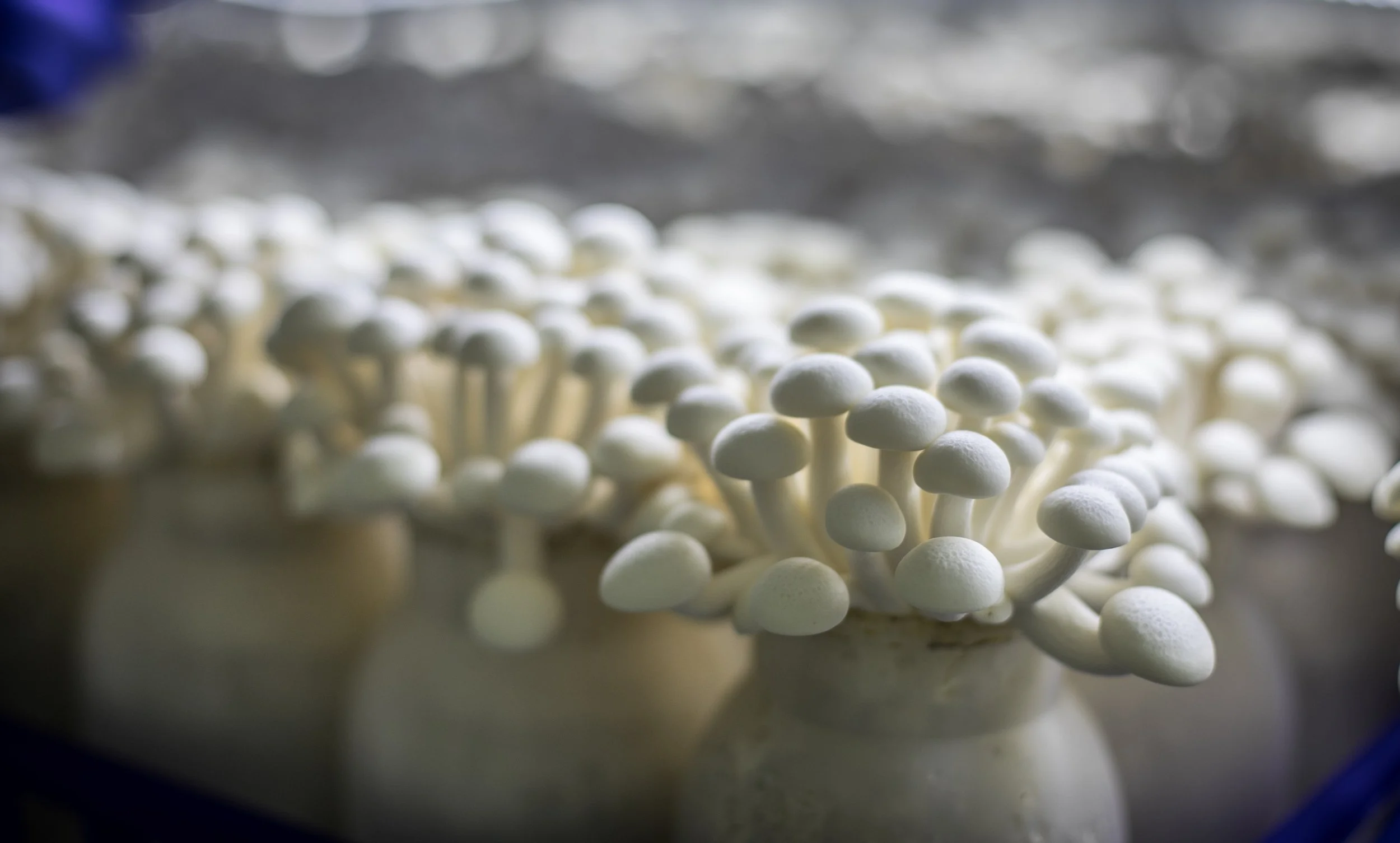
The Mycocultural Revolution
Let’s feed the next billion with mushrooms.
Sit around the dining table with our founder David Law long enough and, soon enough, you will learn about how mushrooms will save the world: by feeding Earth’s growing population nutritionally dense foods with light environmental impact and good economics for both farmers and consumers.
Farming Practices
Raw Materials
One man’s waste is another’s treasure: we grow our mushrooms on a mixture of fibrous substrate made up of the waste products of other agricultural industries — materials such as sawdust, soybean hulls, and corn cobs.
Vertical Farming
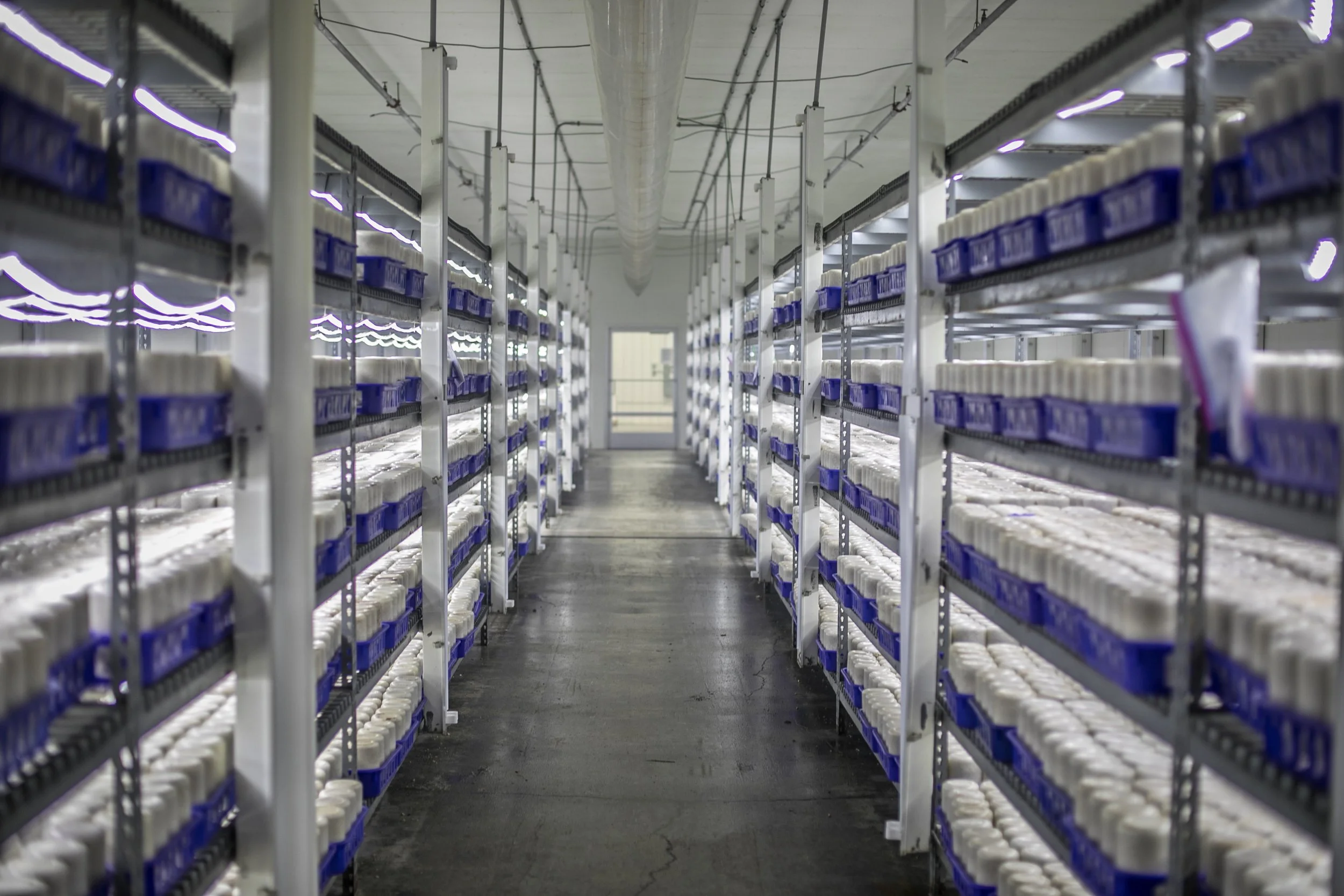
Fungiculture is well suited for vertical farming. We are able to replicate the forest floor thousands of times over by stacking our mushrooms in dense racks and stimulating year-round production — a land- and resource-efficient production process.
Finished Substrate
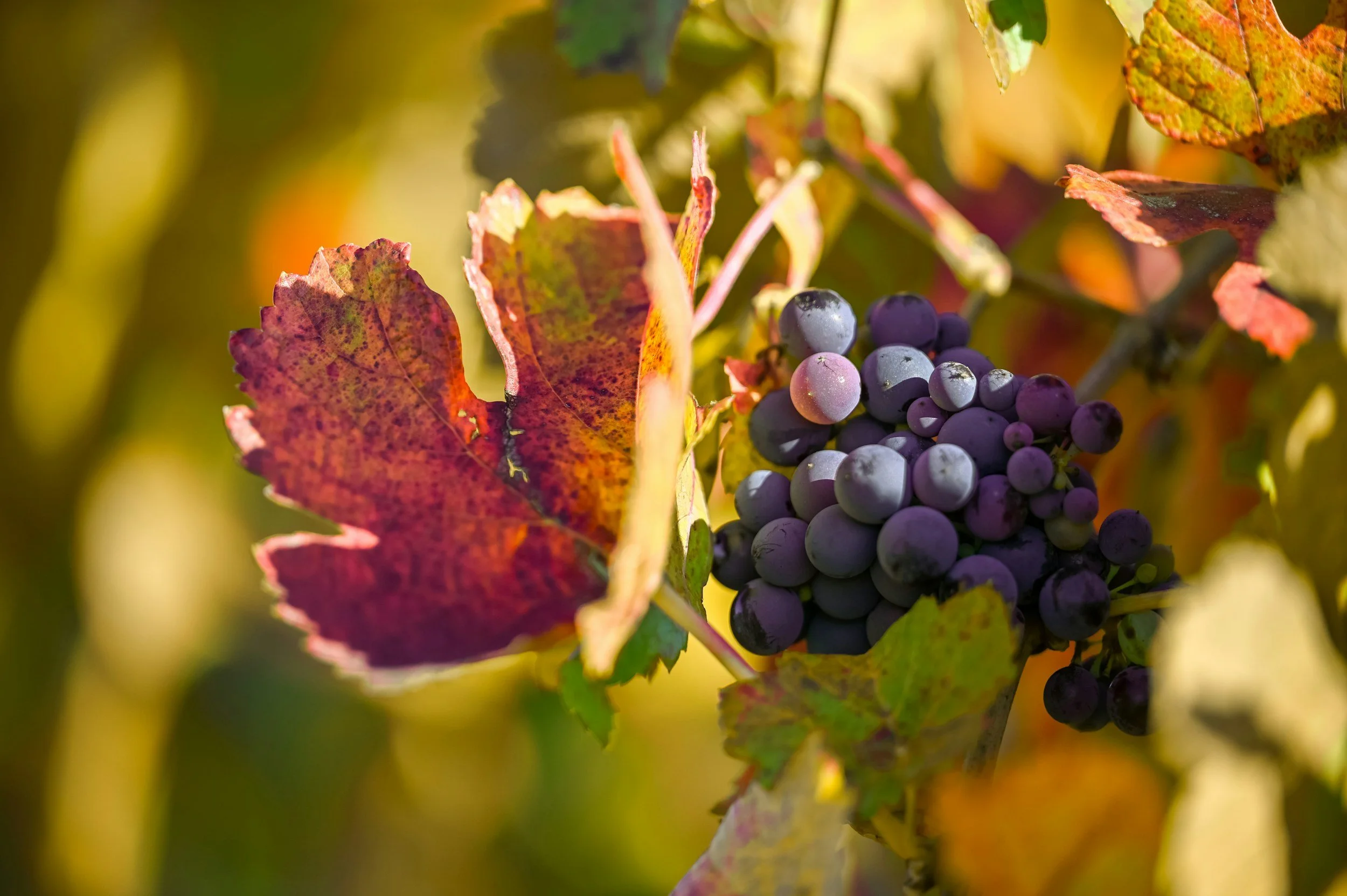
Our finished substrate is sought after as a rich soil amendment. Once the mushrooms are harvested, the substrate that remains is sown into the soil of agricultural crops like our neighbors’ vineyards.

Packaging & Sustainability
We’re proud to be part of such an efficient, circular food production system. But once the mushrooms are harvested, we have to make tough choices to get them to you in peak condition — for example, between food quality and food waste, between packaging costs and food prices, or between recycled materials and recyclable materials.
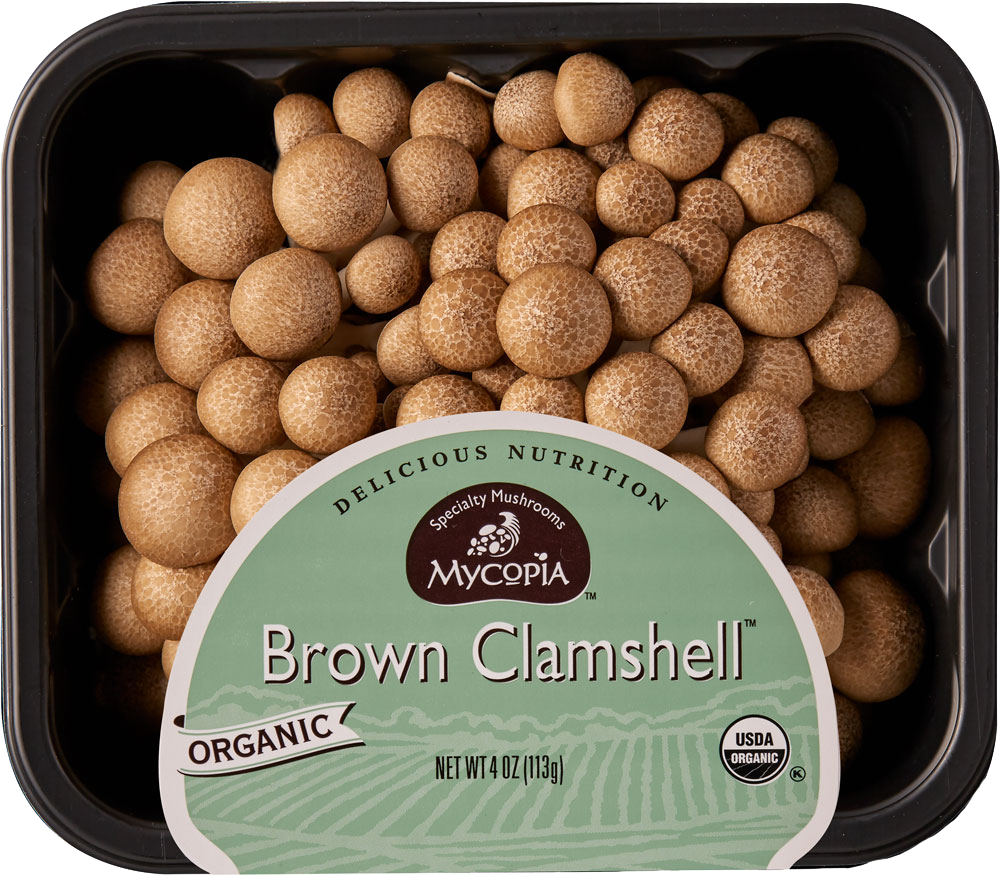
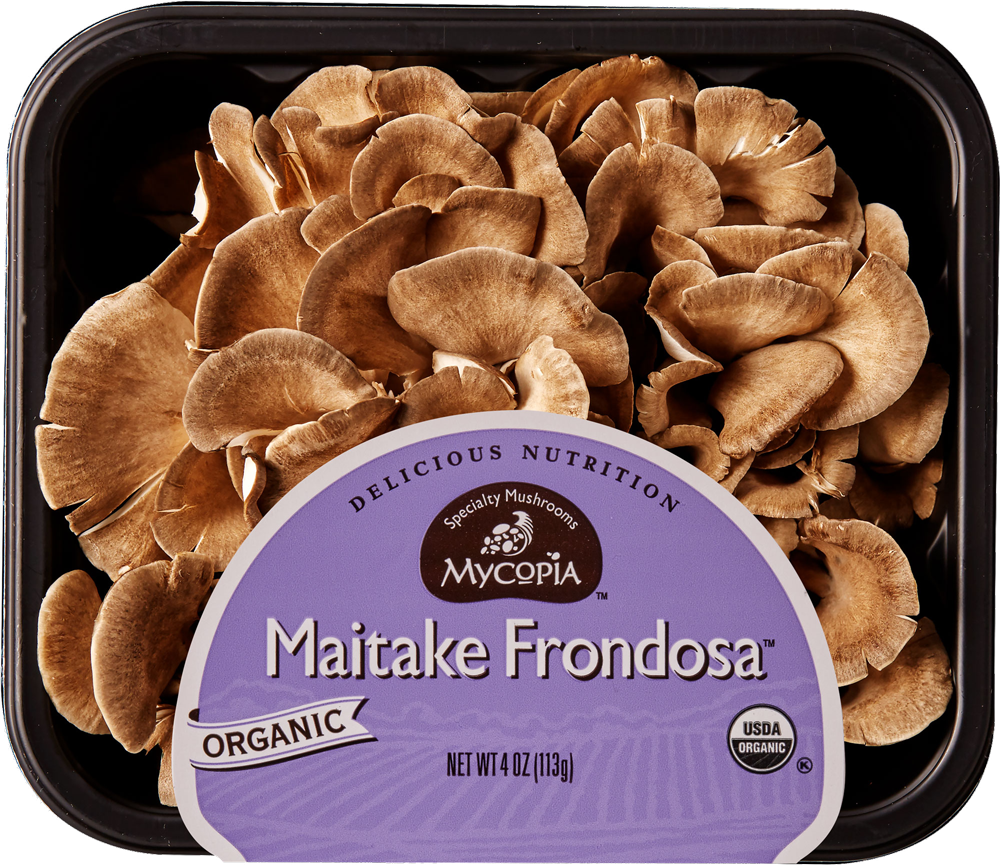
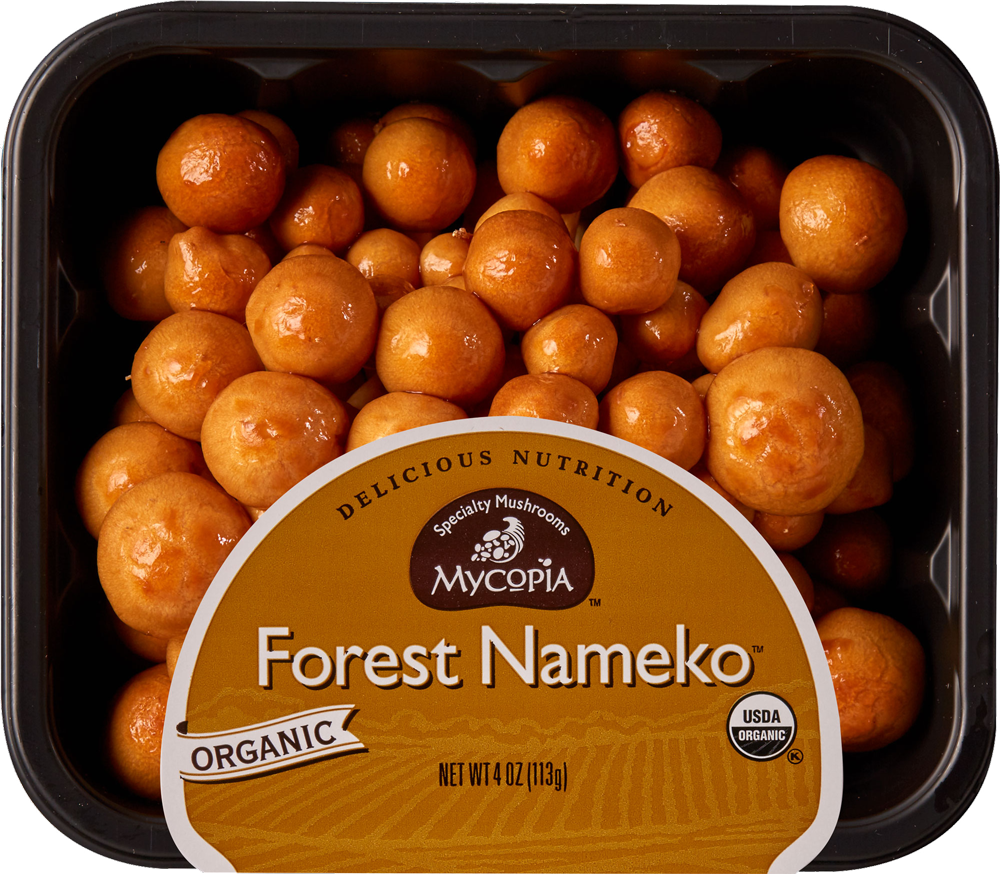
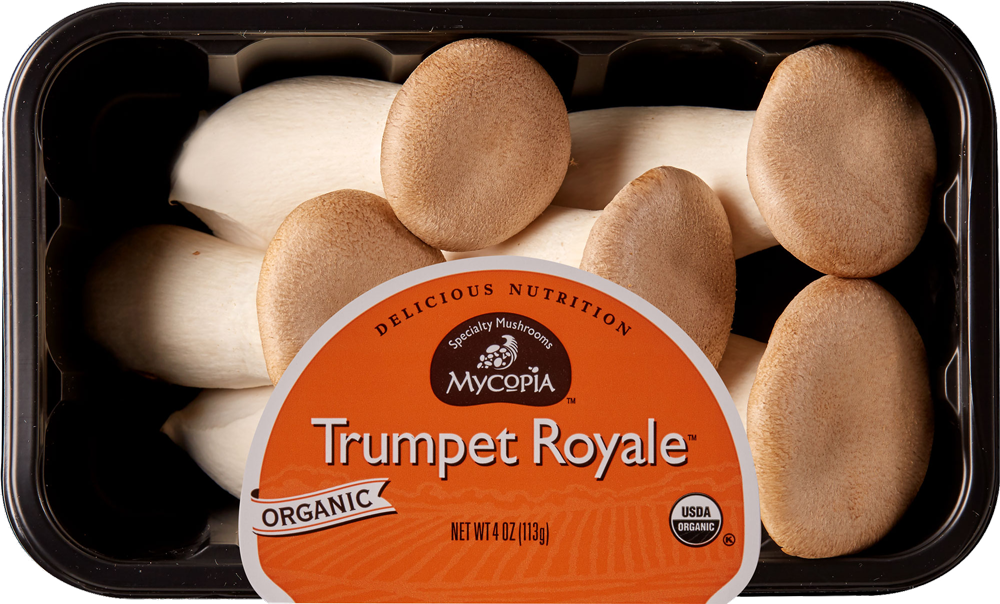
Why is this so hard?

Because of me.
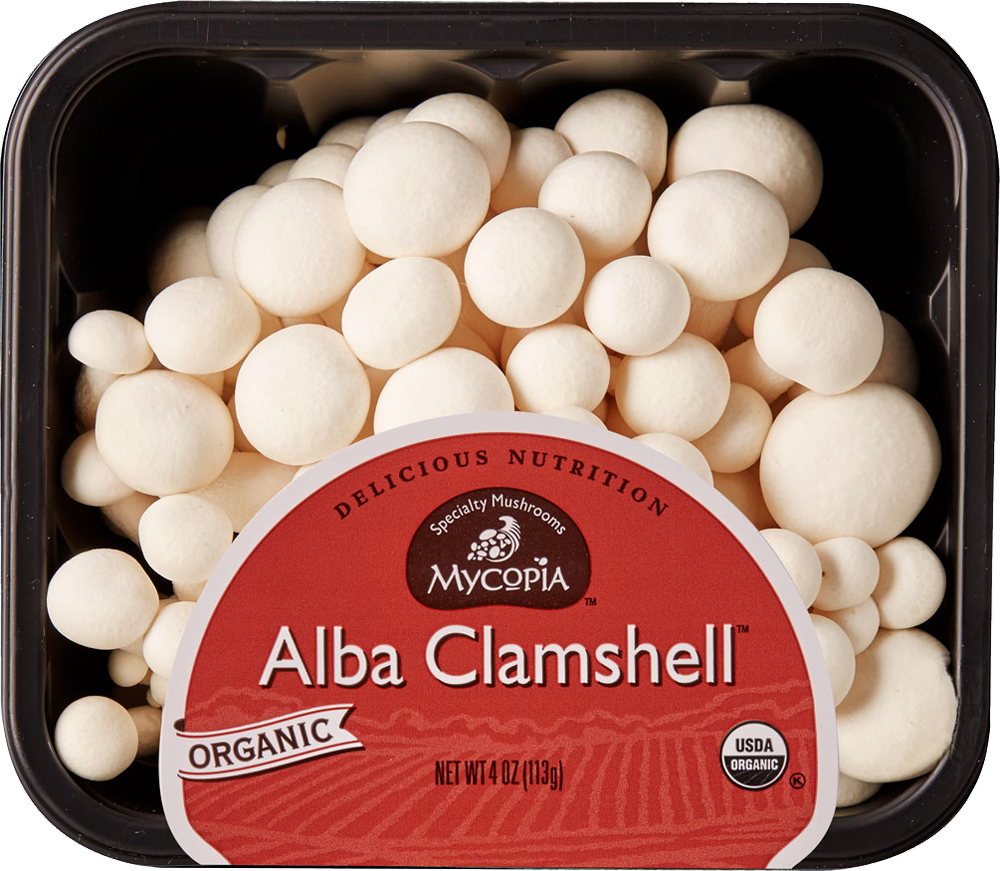
Hi, I’m Albie the Alba Clamshell. I’m a ferocious forest mushroom. In the wild, my job is to be a primary decomposer: I find fallen trees and I eat them.
And when you put me in a nice box made of chopped up trees... I’m gonna eat that too.
Like most fresh produce, mushrooms deteriorate in packaging that allows oxygen exchange. On top of that, our particular varieties — particularly the Alba Clamshell and Brown Clamshell — try to eat pretty much every part of packaging that is made from materials that are commercially or home compostable.
What does that look like? They myceliate, growing little, exploring tendrils called hyphae. And those hyphae look a lot like fuzzy, white mold. While totally safe to eat — they are just extensions of the fresh mushrooms — this growth is catastrophic for shelf appeal and usually consigns perfectly good food to the trash, packaging and all.
The ferocity of our tough little Clamshell mushrooms means that uncoated fiber tills, increasingly common on shelves today, are not an option for us. To use cardboard tills, we would need to use ones with plastic coatings on the interiors — coatings that undermine many of the sustainability gains from avoiding PET plastic trays.
Our Packaging Priorities
These are the priorities that guide our packaging decisions today. They are driven by our sustainability mission and shaped by the economic realities of our business and the biological realities of our specific mushroom varieties. Other operations, developing their own priorities, may take different paths to packaging nirvana. We think that is to be expected, and that we’re all working toward the same vision, even if the paths look different. We’ll continue sharing — and demonstrating — our progress as we go.
1
Minimize food waste, maximize food quality
30-40% of the American food supply ends up uneaten, wasting the resources and labor used to produce it and comprising the single biggest source of US greenhouse gas-emitting landfilled and combusted waste.
Our mission is to feed more people more mushrooms — to have sustainably grown, nutritious foods take up a greater “share of stomach,” as we say. So our first sustainability priority is to get our mushrooms to your plate.
Today’s shrink-wrapped plastic tills maximize food quality, extend shelf life, and are reliably low cost, helping us keep our prices stable. As a bonus, their manufacture likely has lower carbon and water footprints than coated cardboard. (We need that coating — which condemns cardboard to landfill — to avoid myceliation.) Yes, let’s be clear, these are only two factors in a much more complex total impact story — but they illustrate the complexity of evaluating the sustainability of any process or material.
What does this mean in practice to have this as our first priority? It means that if a packaging option achieves a different sustainability outcome but meaningfully increases spoilage or shrink, we pass on that option.
2
Limit the virgin plastic that enters the system
Any use of newly manufactured plastic pretty much locks in future waste. So our next priority is limiting our use of virgin plastic by:
Increasing post-consumer recycled (PCR) plastic where feasible.
Reducing overall material use through using lighter weights and design efficiency
Staying informed on emerging materials and manufacturing methods and participating in partnerships to test these novel materials on their path to commercial viability.
Today, our plastic tills are made from ~70% reclaimed plastic. About 30% of the tills are made with virgin plastic, which adds rigidity.
3
Keep our packaging out of landfills and incinerators
We want to use packaging that can be recycled, commercially composted, or home composted — and that will realistically follow their intended end-of-life pathway. That means privileging materials and formats that are widely accepted by existing recycling or commercial composting systems and that perform consistently in real-world disposal conditions.
In the real world, extending shelf life is one of the best ways we keep our packaging out of landfills and incinerators, because when retailers dispose of inventory, they usually pitch the whole package directly into landfill.
In 2026, we have begun phasing out our black plastic tills for clear plastic to improve their real-world recyclability. The black tills are recyclable — that badge is stamped right there on the till — but the reality of most municipal waste facilities is that many have machinery that cannot detect and divert dark colored plastics. Our transition to clear plastic helps improve our packaging’s real-world recyclability.